Capital You Can't Touch: The Two Ways Canadians Leverage Large Permanent Life Insurance
From the Income Tax Act to three real situations — how immediate financing arrangements and shareholder borrowing actually work, the four legal pillars they stand on, whether the loan can genuinely sustain itself, and who should not do this at all.
Capital You Can't Touch
The two ways Canadians leverage large permanent life insurance — from the Income Tax Act to three real situations
Before you start
Both structures discussed here involve leverage. Leverage magnifies efficiency. It also magnifies mistakes.
The last third of this article deals with risk, with whether the loan can genuinely sustain itself, and with who should not do this at all. Please read that far.
Anyone who reads only the first half will come away with a dangerous impression.Figures are calculated using Ontario rates. Rates differ by province — use your own.
This is general educational content. It is not tax, legal, or investment advice.
Three people, one problem
Andrew runs a used-car dealership. His entire business is finding undervalued vehicles, buying them, reconditioning them, and reselling. The dealership turns over roughly $10 million a year. Business is good — and he has no idle cash whatsoever. Every dollar is in inventory or in motion. He wants a large permanent life insurance policy for his family, but the moment he pulls $2 million out for premiums, next year's buying capacity drops by twenty percent. He gets the coverage. The business shrinks.
Beth runs a two-person consulting firm. She does the product work and the client advisory; her assistant handles day-to-day account management. The firm's costs amount to laptops and LLM tokens. It bills about $1.5 million a year and nets $1.2 million before tax. Her problem is the mirror image of Andrew's: she has more money than she knows what to do with. It sits in the corporation. Invest it and she pays more tax. Leave it and inflation quietly eats it. And when she eventually wants to spend it, she discovers that every dollar coming out is taxed on the way.
Chris is an engineer. His father died two years ago and left him $3 million. Once he had it, he realised he didn't need to work: $3 million invested returns enough to live on. His daughter was born three years ago, and he's started thinking about what happens if he isn't around — his wife doesn't follow his investment approach at all. He wants $5 million of coverage. The premium is roughly $150,000 a year, and it has to come out of principal. Every dollar of principal he spends reduces his income permanently, and he has no salary to replace it.
Three very different situations. Underneath, the same one:
They are not short of money. They are short of money they can touch.
Almost everything written about permanent life insurance assumes the reader has idle capital available. This article is about what happens when that assumption is false.
1. A false choice
The conventional framing is simple. Buying insurance means taking money out of your assets and exchanging it for protection. So you face a trade-off: protection, or growth.
For most salaried households, that framing is accurate. For the three people above it is not — because their principal isn't sitting still. It's producing.
For Andrew, the size of his capital directly determines the size of his business. His money isn't savings; it's productive capacity. Removing $2 million doesn't mean "$2 million less in the bank." It means twenty percent fewer cars next year — and that gap compounds.
For Chris it's more absolute. His entire income is the output of his principal. Spend the principal and income falls permanently, with no way back.
So for both of them, "protection vs. growth" isn't a one-time trade. It's a continuing bleed.
The argument of this article:
That trade-off can be dismantled structurally.
But the cost, the conditions, and the risks deserve more of your attention than the benefits do.
2. Two tools: front-end and back-end leverage
The Canadian industry divides insurance-backed borrowing into two categories. The terminology comes from Canada Life's technical article Collateral life insurance deduction (June 2022), and this article uses it throughout:
| Front-end leverage Immediate Financing Arrangement (IFA) |
Back-end leverage Shareholder borrowing / corporate insured retirement |
|
|---|---|---|
| When borrowing starts | The same year premiums are paid | After 10–20 years of funding |
| What the money does | Goes back into the business or investments must have an income-earning use |
Funds retirement cash flow |
| Problem solved | Liquidity — operating capital stays deployed | Extraction — getting money out of the corporation |
| Who it suits | Fully deployed operators with a better use for cash | High retained earnings, no reinvestment outlet |
| Case here | Andrew, Chris | Beth |
The distinction is less technical than it sounds:
- Front-end asks: "I need my capital working right now. Can I buy insurance without taking it out?"
- Back-end asks: "I can't spend what I've accumulated. How do I get it out without losing half of it to tax?"
One policy, one legal foundation, two entirely different uses. That shared foundation is the next section.
📊 Figure 1 | Front-end vs. back-end timeline (to be inserted)
3. The legal foundation
This is the heart of the article.
Most writing on these strategies skips straight to how much tax you'll save.
When the conditions aren't met, you save nothing — and can end up worse off than if you'd done nothing.
The structure rests on four pillars. Remove any one and the arrangement becomes a different thing entirely.
3.1 Pillar one: why a collateral loan isn't taxable
There are three ways to get at the cash value inside a policy, and they are taxed completely differently:
| Method | A disposition for tax purposes? | Tax result |
|---|---|---|
| Collateral loan (policy pledged to a lender) | No | Not taxable. Loan proceeds are not income |
| Policy loan (borrowing from the insurer) | Yes (deemed partial disposition) | Taxable to the extent it exceeds ACB |
| Partial surrender / cash withdrawal | Yes | Taxable to the extent it exceeds ACB |
The authority is the definition of "disposition" in Income Tax Act 148(9), which expressly carves out an assignment of an interest in a policy for the purpose of securing a debt or loan, other than a policy loan.
Put plainly: pledging your policy to a bank is, for tax purposes, a non-event. The policy remains yours, the cash value keeps compounding tax-sheltered inside it, and you receive cash that isn't income.
This is where the whole structure starts. Canada Life's conclusion in Accessing cash value from a corporate-owned life insurance policy using collateral loans is that a collateral loan is generally the most tax-effective way to access policy cash value.
⚠️ The line you cannot cross: the loan must not constitute a policy loan within the meaning of 148(9). It has to be a genuine, separate loan from an external financial institution, with the policy serving only as security. iA Financial Group flags this specifically in its IFA implementation guide. Get the structure wrong and the entire amount flips from non-taxable to taxable.
3.2 Pillar two: interest deductibility — where most arrangements fail
If pillar one determines whether you can, this one determines whether it's worth doing. Its conditions are considerably stricter than most people assume.
The authority is ITA 20(1)(c), with four requirements:
- Paid in the year or payable in respect of the year
- Paid under a legal obligation
- On borrowed money used for the purpose of earning income from a business or property
- A reasonable amount
The first two are rarely an issue — there's a loan agreement with a bank at a market rate. The entire battle is over the third.
CRA's position lives in Income Tax Folio S3-F6-C1, Interest Deductibility — the document cited most often in this article.
The direct use test. The Supreme Court established in Bronfman Trust, Shell, and Singleton that what matters is what the borrowed money directly bought. And at ¶1.32:
The onus of tracing is on the taxpayer.
You have to be able to show where the money went. No trace, no deduction. This is why serious implementations run borrowed funds through segregated accounts — what the folio calls cash damming (¶1.34).
⚠️ Warning one: capital gains are not "income"
This is the paragraph worth stopping on. Folio ¶1.27:
the phrase "for the purpose of earning income from a business or property"
does not include a reasonable expectation of capital gains
(see Cassan v The Queen, 2017 TCC 174, at paragraph 414).
Money borrowed to earn capital gains produces non-deductible interest.
And the consequence cascades — because one of the conditions for pillar three (the 20(1)(e.2) collateral insurance deduction) is that the loan interest be deductible. Break one, and two break together.
✅ But there's a way through: ¶1.70
CRA's position is not as absolute as it first appears. Folio ¶1.70:
Where an investment does not carry a stated interest or dividend rate, such as some common shares, it is necessary to consider whether the purpose test is met. Generally, the CRA considers interest costs in respect of funds borrowed to purchase common shares to be deductible on the basis that at the time the shares are acquired there is a reasonable expectation that the common shareholder will receive dividends. …
These comments are also generally applicable to investments in mutual fund trusts and mutual funds.
The test only fails where the issuer has asserted it does not pay dividends, doesn't expect to, and shareholders must sell to realise value (the folio's Example 11).
Two further points widen the door considerably:
- Ludco (SCC 2001, folio ¶1.26): earning income need only be a genuine ancillary purpose — not the dominant one
- ¶1.69: the income need not exceed the interest expense; the deduction is neither denied nor capped on that basis
Which produces a distinction worth isolating:
"My returns come as capital gains" — how you experience the outcome
≠
"My portfolio carries no reasonable expectation of income" — what the law actually asks
The law asks whether, at the time of investment, there was a reasonable expectation of taxable income. Not which component of the return turned out largest. Holders of common shares, ETFs and mutual funds generally clear this. Holders of deliberately non-distributing growth vehicles, cryptocurrency, or a pure trading book do not.
⚠️ Warning two: interest on money borrowed to buy a policy is never deductible
Folio ¶1.59 is explicit: interest on borrowed money used to acquire a life insurance policy is specifically excluded from deduction under 20(1)(c)(i).
This single rule dictates the operating sequence of every IFA:
You must pay premiums with your own money first, and borrow afterwards to invest.
You cannot borrow to pay premiums.
Reverse the order and the structure collapses. This is exactly why Canada Life defines front-end leverage as a business using its own funds to pay premiums and then taking bank loans to be made whole. The sequence isn't stylistic. The statute forces it.
Back-end only: "filling the hole"
Back-end arrangements have a particular problem. The corporation borrows, then pays the money out to the shareholder as a dividend. The direct use is paying a dividend — which doesn't look like earning income. So how is the interest deductible?
CRA provides an exception at folio ¶1.48–1.52:
Interest expense on borrowed money used to redeem shares, repurchase shares for cancellation or return capital can be an exception to the direct use test… the purpose test will be met if the borrowed money replaces capital (contributed capital or accumulated profits) that was being used for eligible purposes…
The key concept in this context remains that of filling the hole of capital withdrawn from the business.
Accumulated profits are generally the corporation's retained earnings, computed on an unconsolidated basis with investments at cost. This rule is the sole basis on which back-end interest deductibility rests. Canada Life calls it the "fill-the-hole" concept.
An easily missed detail: 20(1)(d)
ITA 20(1)(d) provides that compound interest is deductible only in the year it is actually paid.
This explains a manoeuvre that otherwise looks pointless: why do lenders typically require you to pay the interest monthly and then draw it back from the line of credit?
Because accrued, capitalised interest becomes compound interest and can't be deducted currently. "Pay it, then re-borrow it" isn't circular — it protects the deduction. (Canada Life explains this in a footnote to the article cited above.)
This detail returns — decisively — in section 7.
3.3 Pillar three: the collateral insurance deduction, 20(1)(e.2)
Life insurance premiums are generally not deductible (ITA 18(1)(b)). Sun Life notes in Corporate ownership of a life insurance policy that there is exactly one exception: 20(1)(e.2).
Four conditions:
- A premium is payable under the policy in respect of the year
- The lender requires the assignment of the policy as collateral, under the terms of the loan
- The lender is a "restricted financial institution" as defined in ITA 248(1) — broadly, a bank, trust company, credit union, insurance corporation, or a corporation whose principal business is arm's-length lending
- The interest on the loan is deductible
Then two ceilings apply:
- Take the lesser of (premiums payable, NCPI) for the year
- Then prorate by outstanding loan ÷ death benefit
Example: a $1,000,000 death benefit with $200,000 owing through the year means only 20% of the lesser amount is deductible. (CRA document 2006-0174781C6 confirms the death benefit as the primary variable in this proration.)
⭐ A technical point almost nobody covers: participating whole life and universal life are treated differently here
At the 2007 APFF conference (CRA document 2007-024191), CRA confirmed that amounts a universal life insurer withdraws from the accumulation account to cover insurance costs and related fees do not constitute premiums.
This means a UL policy earns no deduction in any year the owner doesn't write a cheque.A participating whole life policy, by contrast, specifies each premium in the contract — which supports the position that a premium remains payable even while the policy is on dividend offset.
This is one of the technical reasons IFAs today are written almost exclusively on participating whole life.
The same distinction returns in section 8.3, with more serious consequences.
CRA document 2007-0219601E5 adds a structural constraint: the policyholder and the borrower must be the same person or entity.
One last point: this deduction grows in value with age, because one of its ceilings is NCPI, which rises as the insured gets older. It matters most in the later years.
3.4 Pillar four: the capital dividend account
This pillar exists only where a corporation owns the policy.
Paragraph (d) of the "capital dividend account" definition in ITA 89(1): life insurance proceeds received by a private corporation, less the policy's adjusted cost basis immediately before death, credit the CDA. Amounts in the CDA can be paid out as tax-free capital dividends to Canadian-resident shareholders.
Sun Life's illustration:
A private corporation is the beneficiary of a $1,000,000 policy. The ACB at death is $150,000.
$850,000 is credited to the CDA and can be paid to shareholders tax-free.
The remaining $150,000 can only be paid as a taxable dividend.
Constructive receipt where the policy is pledged. An obvious question: if the policy is assigned to a bank and the proceeds go straight to the lender, the corporation never touches the money — does the CDA credit survive?
It does. At Income Tax Folio S3-F2-C1, Capital Dividends ¶1.66–1.67, CRA confirms that where a policy is assigned as collateral security (rather than absolutely), the debtor is treated as having constructively received the proceeds and the CDA is credited accordingly — while the creditor gets no CDA credit of its own. The Federal Court of Appeal applied the same logic in Innovative Installation Inc. v. The Queen (2010 FCA 285).
⭐ Which creates additional room. Because the CDA credit is computed on the full death benefit less ACB — not on the amount left after the loan is repaid — there is often unused CDA capacity remaining after the debt is cleared. That capacity can carry other corporate assets out to the estate tax-free. iA's implementation guide highlights this; it is one of the more underrated features of back-end leverage.
3.5 Two side effects of corporate ownership
Articles that only list benefits aren't worth trusting. Corporate ownership carries two costs:
It can taint QSBC status. Policy cash value is not an active business asset for the purposes of the "qualified small business corporation share" definition in ITA 110.6(1). Accumulate enough of it and the shares may fail the test, jeopardising the lifetime capital gains exemption on a future sale. Both iA and Sun Life flag this by name.
It interacts with the passive income rules — favourably. Under ITA 125(5.1), once a corporation's adjusted aggregate investment income exceeds $50,000, every additional dollar reduces the small business deduction by $5, eliminating it entirely at $150,000.
Growth inside an exempt policy is not included in AAII.
For Beth, this is decisive. Section 5 develops it.
3.6 Why the corporation pays the premium
Sun Life offers a useful piece of arithmetic. Because premiums aren't deductible, the payor's tax rate determines the real cost:
| Who pays $5,000 of premium | Rate | Pre-tax income required |
|---|---|---|
| Shareholder personally | 50% marginal | $10,000 |
| Corporation | ~17% | $6,024 |
Roughly $3,976 saved every year on the same premium. Over the life of a policy that compounds into real money.
It also explains why Andrew's and Beth's policies are corporately owned — and why Chris, with no corporation, doesn't get this advantage at all.
4. Andrew — front-end leverage (IFA)
When capital is capacity
4.1 The problem
Andrew's dealership turns over $10 million a year on a simple model: find undervalued cars, buy, recondition, sell. The capital available for buying directly determines the profit he can make in a year.
He wants a large policy at roughly $2 million in annual premium. Pull that out of working capital and next year's purchases drop by twenty percent — and the shortfall compounds.
This is the continuing bleed from section 1.
4.2 How an IFA dismantles it
- The corporation buys a participating whole life policy engineered for high early cash value
- The corporation pays the premium with its own funds (note the sequence — warning two in 3.2)
- The policy is assigned to a lender as security for a line of credit
- Funds are borrowed back against it
- The borrowed money goes back into the business — buying more cars
- Steps 3–5 repeat annually
- On a claim, the loan is repaid from the proceeds and the balance goes to the family
One dollar, doing two jobs. The coverage is in place; the buying capital never left.
4.3 Two structures
Manulife Bank's IFA advisor guide (AB0708E) groups practice into two families:
| 100% CSV lending | 100% replacement of premium | |
|---|---|---|
| Borrowed each year | Only the year's cash value (less than premium) | The full premium |
| Additional collateral | Not required | Required |
| Advantage | Simple; borrowing capacity compounds quickly | Net outflow is only the after-tax interest |
| Drawback | Significant net outflow in early years | You must post additional security |
Manulife Bank's accepted additional collateral includes the cash value of an existing permanent policy, GICs, an assignment of a non-registered portfolio, letters of credit from Schedule 1 banks and certain named institutions, and residential real estate in first position. Notably, that additional collateral requirement typically shrinks over time and eventually disappears as the policy's own cash value grows.
4.4 The terms
Lender conditions vary and change. Using Manulife Bank's currently published terms as a reference point:
- Loan to value: up to 100% of cash value on whole life; 90% on universal life invested in guaranteed interest accounts; 50% on universal life invested in equities
- Minimum size: the current page states $1,000,000 over ten years ($100,000/year), negotiable — while the 2019 advisor guide stated $300,000 over ten years
- Rate: a variable annual rate, calculated on daily closing balance and charged monthly
- Fees: an application fee around 0.25%, plus an annual review fee
⚠️ Minimums and advance rates vary widely between lenders and across years. Treat any fixed statement of them with suspicion — what governs is the written commitment from your lender at the time you apply.
Where the corporation owns the policy but the shareholder is the borrower, one cost is routinely overlooked: the guarantee or collateral fee. iA's guide gives the industry convention — 1% to 2% of amounts borrowed — and notes it constitutes taxable income to the corporation. Section 5.5 explains why it isn't optional.
4.5 The second problem, waiting at retirement
When Andrew stops trading at 65, the corporation will be holding $60–70 million in retained earnings.
He needs $2 million a year to live on. Coming out of the corporation, that's a taxable dividend:
| Amount | |
|---|---|
| Annual withdrawal | $2,000,000 |
| Annual tax (Ontario, non-eligible dividend, top rate 47.74%) | ≈ $955,000 |
| Cumulative tax over 30 years | ≈ $28.65 million |
(If the corporation has a GRIP balance permitting eligible dividends at 39.34%, this falls to roughly $787,000 a year, or $23.6 million over 30 years. Which applies depends on the corporation's tax attributes and should be modelled by its accountant.)
Nearly $29 million in tax. This is Andrew's real exposure — and the CDA exists precisely for it. Proceeds less ACB credit the CDA and flow to his heirs tax-free; unused CDA capacity remaining after the loan is repaid can carry other corporate assets out as well.
5. Beth — back-end leverage (shareholder borrowing)
Her problem isn't tax. It's that the money runs out.
5.1 The arithmetic
Beth's firm bills $1.5 million and nets $1.2 million before tax.
Corporate tax (Ontario):
| Calculation | Tax | |
|---|---|---|
| First $500,000 at the small business rate (12.2%) | $500,000 × 12.2% | $61,000 |
| Remaining $700,000 at the general rate (26.5%) | $700,000 × 26.5% | $185,500 |
| Total | $246,500 |
(The small business rate applies only to the first $500,000 of active business income; the balance is taxed at the general rate.)
$953,500 stays in the corporation each year. Over ten years, she retires at 50 with roughly $9.53 million.
5.2 The part nobody has told her
She plans to draw $500,000 a year from age 50 to age 90 — forty years.
| Scenario | How long $500,000/year lasts | Age when it runs out |
|---|---|---|
| Cash, zero return (what she does now) | 19 years | 69 |
| Invested, ~3% net | ~29 years | 79 |
| What she wants | 40 years | 90 |
She runs out at sixty-nine.
This is not a question of trimming her tax bill. The money isn't enough — and she doesn't know it, because the number on the balance sheet looks large.
5.3 Why she won't invest it — and why she's right
Asked why nearly ten million dollars sits idle, her answer is: investing it means more tax.
She's correct, and the effect is larger than she realises. Under ITA 125(5.1), once AAII passes $50,000, every additional dollar grinds the small business deduction by five, eliminating it at $150,000.
For her:
| Corporate tax | |
|---|---|
| Small business deduction preserved | $246,500 |
| Small business deduction fully ground away ($1,200,000 × 26.5%) | $318,000 |
| Additional annual tax | $71,500 |
So both of her options fail:
- Leave it idle → zero return → out of money at 69
- Invest it → triggers AAII, costs $71,500 a year in additional corporate tax → out of money at 79
And under either path, the money still has to come out as a taxable dividend eventually.
5.4 A third path
Phase one — accumulation (now to 50).
The corporation funds a participating whole life policy from surplus cash. Growth inside the policy is not included in AAII — the small business deduction survives, and the money finally earns something instead of nothing.
Phase two — distribution (50 onward).
Beth borrows personally from a lender, with the corporation pledging the policy as security. Loan advances are not income and are not taxed (section 3.1). She receives spendable cash rather than a dividend reduced by more than forty percent.
Phase three — legacy.
Proceeds are paid to the corporation, the excess over ACB credits the CDA, tax-free capital dividends flow to her estate, and the estate retires the loan.
5.5 ⚠️ Get this wrong and the rest was pointless: subsection 15(1)
The corporation is pledging its own asset to secure the shareholder's personal debt. Is that a benefit conferred on the shareholder?
CRA's position (document 2006-0174011C6, 29 June 2006) is that this can only be determined on the full facts, with no bright-line guidance. But it lists three factors:
- Whether the shareholder and corporation deal at arm's length
- Whether there is evidence the shareholder could not repay at the time support was given
- Whether the shareholder pays a reasonable fee for the guarantee or security
CRA also confirms that no benefit arises where reasonable consideration is paid.
Hence standard practice: the shareholder pays the corporation a guarantee fee (conventionally 1–2% of amounts borrowed), which is taxable income to the corporation. Equitable Life's shareholder borrowing checklist instructs advisors to build the fee into the illustration.
⚠️ There is no safe harbour here. At the 2024 CALU roundtable (CRA document 2024-1007091C6), asked about a related shared-ownership structure, CRA declined to confirm that no taxable benefit arises, saying only that it must be assessed case by case.
Anyone telling you a structure of this kind is "CRA-approved" either hasn't read that document or is misleading you.
5.6 ⚠️ The settlement sequence — one wrong step destroys the CDA
This is the least-discussed and most easily botched step in the entire back-end structure.
Wrong: proceeds go directly to retire the shareholder's personal loan.
→ Risks being treated as a benefit conferred on the shareholder, and damages the CDA computation.
Right (per Equitable's checklist):
- The corporation arranges in advance with the insurer to delay paying proceeds directly to the lender
- The executor asks the lender to accept alternative collateral in the interim
- Proceeds are paid to the corporation first
- The excess over ACB credits the CDA
- The corporation pays tax-free capital dividends to shareholders, including the deceased's estate
- The estate retires the personal loan
The order is not negotiable. It requires the lender, the corporation, the executor and their respective tax and legal advisors to have agreed the mechanics in advance — not on the day of the claim.
5.7 ⚠️ The RCA trap
Where a corporation buys a policy to fund an obligation to provide retirement benefits to an employee, CRA may treat the arrangement as a Retirement Compensation Arrangement, with entirely different tax consequences.
The distinction: this must remain a voluntary shareholder arrangement, not a corporate obligation. Both Canada Life and Equitable warn about it explicitly.
5.8 A useful comparison
Equitable Life's shareholder borrowing brochure includes a table showing what pre-tax return other asset classes must produce to match a participating policy's internal rate of return:
| Asset class | Required pre-tax annual return |
|---|---|
| Participating life insurance (internal rate of return) | 5.75% |
| Interest-bearing | 11.49% |
| Dividends | 9.30% |
| Realized capital gains | 7.59% |
| Deferred capital gains | 6.42% |
(Assumes a 50% shareholder marginal rate, 40% dividend rate, and 50% corporate rate on investment income.)
This answers the question that always comes: "Why not just buy a GIC?"
6. Chris — a personal IFA, and "you may not need this"
Establish the need before discussing the financing.
This section is the article's good-faith test. If all three cases ended happily, the article wouldn't deserve your trust.
6.1 The situation
Chris is 40 (assumed for the purposes of this illustration, consistent with the premium level shown), an engineer. His father's estate left him $3 million. Invested himself, it has returned 8–10% annually in his experience — $240,000 to $300,000 a year. He has a three-year-old daughter.
⚠️ The 8–10% figure is Chris's own judgement based on his own experience. It is not a projection or a guarantee by this firm. Section 6.6 examines what happens when it fails.
He wants $5 million of coverage at roughly $150,000 a year. The conflict:
$150,000 × 20 years = $3,000,000
His entire principal would end up inside the policy.
And each dollar removed reduces his income permanently.
6.2 Establish the need first — not the structure
The order matters. In a practical review of IFAs (Micheline Varas, June 2026), the mistake listed first among advisor errors is putting the financing ahead of the insurance need. Her formulation:
The insurance need must stand on its own merit.
So does Chris's? It has two parts, and they don't behave the same way.
Part one: income replacement. A wife and a young child need money if he isn't there. But this need has a shape — it expires. The daughter grows up; the wife reaches her own retirement provision. That shape is term insurance. Five million of term coverage might cost three to five thousand dollars a year, wouldn't touch his principal at all, and would make the entire IFA unnecessary.
If this were Chris's only need, the honest answer is to sell him term insurance, not a leveraged structure.
Part two: legacy. But Chris also wants to leave his daughter meaningful wealth. That need has no expiry. Permanent needs are what permanent insurance is for.
With that, the need stands. ✅
A technical aside: it's often assumed a portfolio like Chris's triggers a large capital gains liability on death that insurance must cover. That's incomplete — the spousal rollover defers it to the second death. The real liquidity need arrives after both spouses are gone, which affects whose life should be insured — his alone, or a joint last-to-die policy.
6.3 "My wife doesn't understand investing" — take that apart
One of Chris's stated motivations is that his wife couldn't manage his portfolio.
Half of that doesn't support the conclusion. Insurance solves a money problem, not a competence problem. If his wife doesn't follow investing, the answers are a simpler portfolio, a discretionary mandate, or a trust. Buying insurance doesn't teach her anything.
The other half is true and matters. A tax-free lump sum arriving in one payment is genuinely easier for a non-investor to receive than a portfolio requiring active management. It needs no judgement, no timing, and can't be halved by one bad decision.
That is the argument that holds. "She doesn't understand investing, therefore he needs insurance" does not survive a follow-up question.
6.4 A personal IFA is not a corporate one
Chris has no corporation, and that changes the arrangement fundamentally.
What he loses:
- ❌ No CDA — proceeds reach his beneficiary tax-free, but there is no mechanism for moving trapped corporate money out
- ❌ No premium cost advantage — the $10,000-vs-$6,024 arithmetic in 3.6 doesn't apply to him
What he gains:
- ✅ Policyholder = borrower = the same person, satisfying CRA document 2007-0219601E5 directly
- ✅ No guarantee fee and no subsection 15(1) exposure — structurally, his is the cleanest of the three
Which means his case rests entirely on "principal stays deployed" plus the two deductions, with no corporate tax cushion underneath. Those deductions aren't a bonus for him. They're load-bearing.
6.5 ⭐ The technical core: the capital gains trap
Chris describes his 8–10% as capital gains.
Taken literally, that sentence is enough to void the arrangement:
- Borrowed money used to earn capital gains → interest not deductible (folio ¶1.27; Cassan)
- One condition of 20(1)(e.2) is that the loan interest be deductible → the collateral insurance deduction fails too
- → He pays fully non-deductible interest and receives only "principal stays deployed" in return
But that conclusion arrives too fast. Return to the distinction in 3.2:
"My returns come as capital gains" ≠ "My portfolio carries no reasonable expectation of income"
So the question to ask Chris isn't whether his returns are capital gains. It's:
What, specifically, does the portfolio hold?
- Common shares, ETFs, mutual funds → under ¶1.70, interest is very likely deductible ✅
- Deliberately non-distributing growth vehicles, cryptocurrency, or a pure trading book → not deductible ❌
And there is a cleaner structural answer:
The direct use test looks at what the borrowed money bought — not at what the rest of his portfolio holds. So:
Direct the borrowed funds specifically into income-producing assets (dividend-paying equities, income ETFs, REITs, bonds),
and leave his original $3 million growth strategy untouched.
20(1)(c) is satisfied cleanly, 20(1)(e.2) is restored, and he doesn't have to change how he invests. Run through a segregated account (the cash damming discipline of folio ¶1.34), the tracing is unambiguous.
This is why Chris is the most instructive of the three cases: he teaches where the boundary of interest deductibility actually sits.
6.6 Stress test: what if it isn't 8–10% every year?
It won't be. No portfolio delivers that.
And Chris's position has a specific vulnerability worth naming:
His collateral and his income are the same asset.
Andrew still has dealership cash flow. Beth still has consulting revenue. Chris has no salary. In a drawdown year:
- His portfolio is shrinking
- His living expenses come from that shrinking portfolio
- The lender still wants interest, and may call for additional collateral
- And the only thing he has to post is the same shrinking portfolio
This is the highest-leverage-risk case of the three — not because the structure is complex, but because there is no uncorrelated second asset to fall back on.
Section 8 generalises this. It turns out to be the deepest risk in any of these arrangements.
7. Can the loan really run forever?
Every prospective client asks this. Most material avoids it.
The answer is yes — but the mechanism is not what most people think it is.
7.1 A natural argument with three faulty premises
The usual reasoning:
Borrow $100,000 a year for ten years — a $1 million loan. At 5%, that's $50,000 of annual interest.
After twenty years the policy's dividend scale is 6.5%, generating more than $50,000.
So the interest covers itself, and the loan never has to be repaid.
Three premises need correcting.
① 6.5% is the dividend scale interest rate. It is not the return on your cash value.
The DSIR is the rate used within the dividend formula to reflect the smoothed investment return of the participating account. It is not the policyholder's net return. After mortality costs, expenses and tax, the long-run net internal rate of return on participating cash value typically lands between 3.5% and 5%.
(Compare Equitable's table: the 5.75% figure there is the IRR at claim, not the annual growth rate of cash value. They are very different numbers.)
Comparing 6.5% to a 5% loan rate is comparing two different measures.
It is the single most common piece of misdirection in this field — sometimes deliberate, often simply careless.
② Dividends aren't cash unless you take them as cash — and taking them as cash breaks two things at once.
Every IFA design uses the paid-up additions (PUA) dividend option, because it maximises early cash value. A PUA dividend buys additional paid-up insurance. It is not cash.
To use dividends to service interest you must switch to a cash dividend option, which:
- ❌ Halts cash value growth — and cash value is the collateral the whole structure depends on
- ❌ Reduces the policy's ACB; once ACB is exhausted, further cash dividends become taxable income (ITA 148)
Which is why virtually nobody does it.
③ What actually makes it self-sustaining is something else entirely.
Pay the interest, then draw it back from the line of credit.
Why the detour? Because ITA 20(1)(d) allows compound interest only when actually paid (the detail at the end of 3.2). Accrued interest becomes compound interest and can't be deducted currently.
7.2 So it becomes a race
Once the mechanism is clear, "can it run forever" reduces to a clean question:
The loan compounds at the AFTER-TAX interest rate. The cash value compounds at its net growth rate.
- After-tax rate < cash value growth → loan-to-value falls every year → sustainable ✅
- After-tax rate > cash value growth → loan-to-value rises every year → eventually breaches the limit and triggers a collateral call ❌
Modelling from year 20: cash value $1,500,000, loan $1,000,000 (LTV 66.7%), advance limit 90%.
| Scenario | Cash value growth | Loan after-tax growth | Spread | Result |
|---|---|---|---|---|
| Deductible · 5% · normal dividend | 4.5% | 2.5% | +2.0% | ✅ LTV falls to 31% over 40 years |
| Deductible · 8% · normal dividend | 4.5% | 4.0% | +0.5% | ✅ Still only 55% after 40 years |
| Deductible · 8% · dividend scale −1% | 3.5% | 4.0% | −0.5% | ⚠️ Drifts to 81% over 40 years — marginal |
| Not deductible · 5% | 4.5% | 5.0% | −0.5% | ⚠️ Reaches 81% — marginal |
| Not deductible · 8% | 4.5% | 8.0% | −3.5% | ❌ Breaches at year 10 |
| Not deductible · 8% · dividend −1% | 3.5% | 8.0% | −4.5% | ❌ Breaches at year 8 |
(Assumes a 50% marginal rate. Cash value growth is net; the loan compounds at the after-tax rate. Illustrative modelling of the mechanism only — not a projection for any specific policy.)
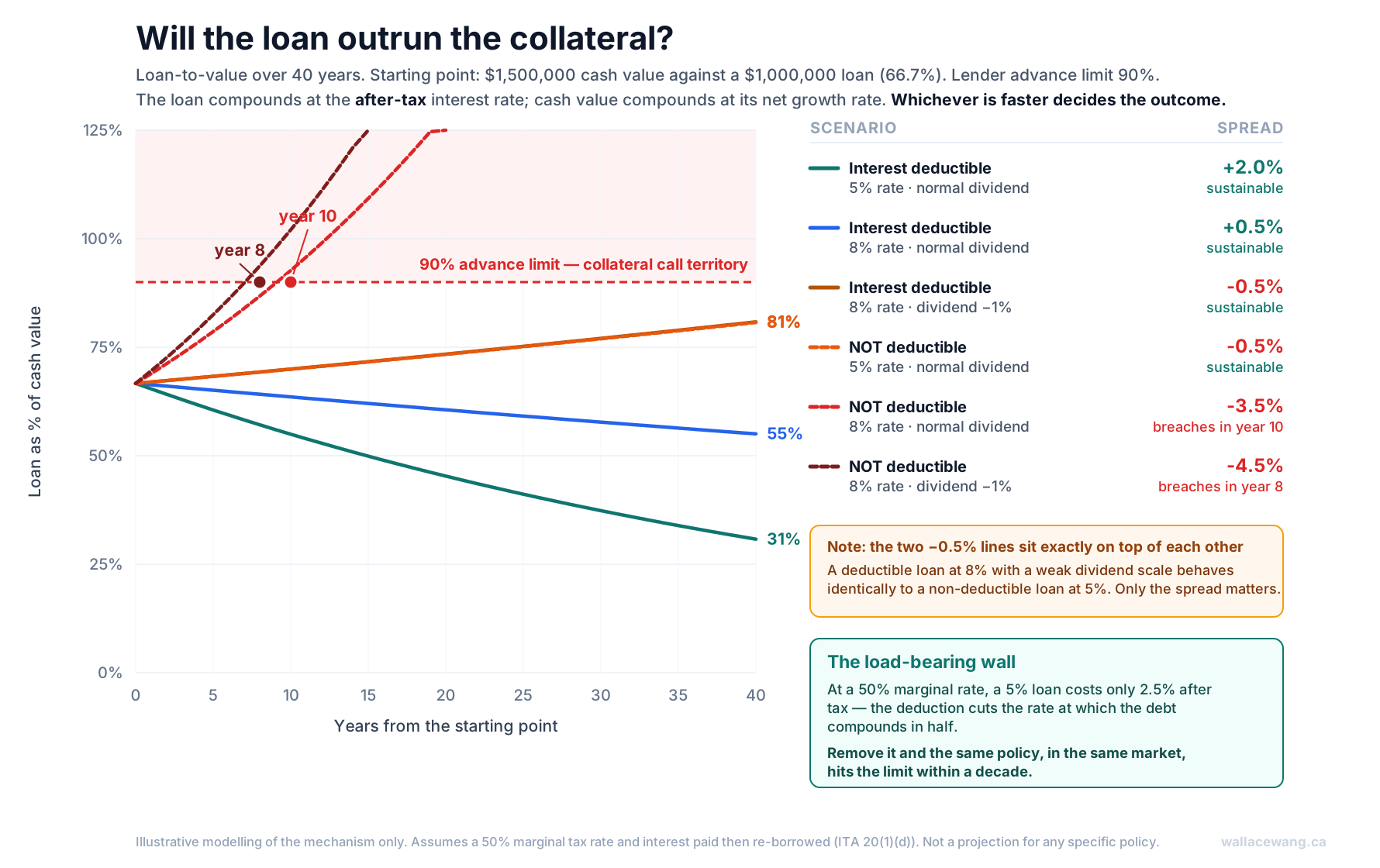
Figure 2 — Whichever compounds faster, the after-tax loan rate or the policy's net cash value growth, decides the outcome. Interest deductibility is what separates the sustainable scenarios from the ones that breach the advance limit within a decade.
7.3 Three conclusions
One: it can sustain itself — but through "after-tax interest cost below net cash value growth," not through "dividends covering interest."
Two: interest deductibility is not a bonus. It is the load-bearing wall.
Look at the first row: at a 50% marginal rate, a 5% loan costs 2.5% after tax — the deduction halves the rate at which the debt compounds.
Now look at row five: same policy, same market, deduction gone — and an 8% rate pushes LTV to the limit within ten years.
This is the real weight of the capital gains trap in section 6. It isn't about saving a bit less tax. It determines whether the structure lasts forty years or eight.
Three: "never repaid during life" is the design, not a loophole.
The loan is retired from the insurance proceeds. It was never meant to be repaid while the insured is alive. So the real question was never whether to repay it. It is:
Can it be carried that far without a collateral call along the way?
7.4 ⚠️ A note on language
Don't describe this as a "perpetual motion machine" — to clients, or in your own head.
That framing implies free money, and this structure is never free money. It exchanges a tax condition that may disappear for an interest cost that certainly won't.
The accurate word is self-sustaining — and it should never appear without its conditions attached.
8. Risk
Equitable Life's shareholder borrowing checklist is the most candid document I've read on this subject. This section follows its structure.
8.1 The deepest risk: correlation
If you remember one thing from this section:
One event severs three legs at once.
A downturn in the business simultaneously causes:
- Premiums become unaffordable → the policy never reaches the point where dividends can carry it
- There's no longer taxable income → the interest deduction has nothing to offset
→ the loan's after-tax cost jumps from 2.5% back to 5% (see the table in 7.2) - The assets the borrowed money bought are likely falling in the same downturn
These are not independent events. They share a cause.
And virtually every illustration ever produced treats them as independent. That is the blind spot in how this entire industry models these arrangements.
The most dangerous window is policy years one through seven. Cash value hasn't built yet, and none of the exits described below work well.
8.2 A seven-level contingency ladder
When cash flow fails, the responses have an order. From least to most damaging:
| Level | Action | Cost |
|---|---|---|
| 1 | Stop taking new advances | Lightest. The loan simply stops growing |
| 2 | Service interest from other resources | Requires outside liquidity |
| 3 | Use policy dividends to offset premiums | Requires the policy to have matured enough |
| 4 | Reduce premium / stop the additional deposit option | Cash value growth slows → affects the race in section 7 |
| 5 | Reduced paid-up | Permanent reduction in coverage (see 8.3) |
| 6 | Partial surrender | Taxable; collateral shrinks; may breach the advance limit |
| 7 | Full surrender | Worst case: taxable policy gain + loan called + coverage gone |
📊 Figure 3 | The seven-level contingency ladder (to be inserted)
Most people don't know level 1 exists and jump straight to 6 or 7. Level 1 is frequently sufficient — stop drawing, let the loan stop growing, and let cash value growth pull the ratio back down over time. iA's implementation guide lists exactly this as the first remedy for a loan that has outrun its collateral.
8.3 Reduced paid-up: a real exit with three costs
What it is. A non-forfeiture option that converts the policy to fully paid-up status — no further premiums are required — in exchange for a permanently reduced death benefit. Accumulated cash value buys a smaller amount of paid-up coverage outright.
Why it matters here. It addresses the exact pain point in 8.1: it ends the premium obligation before the policy is self-supporting, without surrendering and without triggering a taxable policy gain.
But for an IFA it carries three costs:
Cost one: the coverage shrinks — and the coverage is what repays the loan.
The entire repayment plan is "proceeds retire the debt." Reducing the death benefit demands a recalculation:
After the reduction, what is the death benefit less the loan balance projected to that date?
If the reduced coverage falls below the projected loan balance, the structure has inverted — the estate receives nothing and owes the difference.
Run that number before electing reduced paid-up. It belongs on every annual review checklist for one of these arrangements.
Cost two: the 20(1)(e.2) deduction very likely ends.
Return to the participating-versus-universal distinction in 3.3. The first condition is that a premium be payable in the year. Canada Life's position is that a participating policy on dividend offset still supports that claim, because the contract continues to specify premiums.
But reduced paid-up is not dividend offset. It converts the contract into a paid-up contract, under which no premium is payable at all going forward.
On that logic, the deduction should stop.
⚠️ This is the author's technical inference from the available CRA material. No CRA statement specifically addressing reduced paid-up in this context has been located.
The difference in treatment between offset and reduced paid-up should be confirmed with your accountant before acting.
Cost three: slower cash value growth feeds straight back into the race in section 7.
After reduction there are no new premiums and no additional deposits; cash value grows mainly through dividends on the reduced paid-up amount. The "cash value growth" column in 7.2 moves down — while the loan keeps compounding at the after-tax rate.
Reduced paid-up rescues the premium and may accelerate the breach of the advance limit.
So: it stops the bleeding; it does not cure the condition. It ends the premium obligation, not the interest obligation — the loan remains and interest keeps running. It has to be paired with level 1.
One more caution: reduced paid-up is nearly useless in the early policy years, because cash value is too small to buy meaningful coverage. And the early years are precisely when cash flow is most likely to break.
Which is why "can this survive years one through seven" has to be answered before the policy is issued — not after something goes wrong.
8.4 The rest of the list
Interest rate risk. Manulife Bank's advisor guide requires IFA illustrations to be stress-tested at a loan rate of 5% or higher — a requirement written in a low-rate era. The bar today is higher.
Dividend scale reductions. Dividends are not guaranteed. A reduction delays the point at which the policy supports itself and may require you to keep paying, or resume paying, premiums. Manulife also requires illustrations at dividend scale less 1%.
Exceeding the advance limit. Lenders typically offer four options: pay interest personally, pay down to bring the loan within the limit, post additional collateral, or — iA's fourth — put more money into the policy to raise cash value.
🔴 The worst case: a triple hit. If loan terms aren't met and the lender enforces its security against the policy's cash value:
- The corporation is fully taxed on cash value in excess of ACB
- The loan repaid from the policy may be assessed as a shareholder benefit
- The coverage is gone
One event, three losses.
Frozen policyholder rights. While assigned, you cannot take policy loans, withdraw cash value, surrender, change the coverage amount, change ownership, or convert. Without the lender's written consent, it isn't really your policy.
Lender risk. Lenders can change advance rates and collateral requirements, or exit the market entirely. Manulife Bank's own material notes that competitors have entered this business and later withdrawn.
Tax risk. Everything here rests on current law and CRA's current administrative positions. The next section explains why that isn't boilerplate.
Longevity risk. The longer you live, the larger the loan grows. This is one of very few financial structures in which living a long time is a problem.
9. What has already been shut down
IFAs and shareholder borrowing remain viable precisely because they are not 10/8 arrangements.
This isn't a history lesson. It answers a more useful question: how do you tell whether a structure is durable?
9.1 Budget 2013: 10/8 arrangements and leveraged insured annuities
A 10/8 arrangement tied the loan rate and the policy account's crediting rate to each other — borrow at 10%, credit at 8% — manufacturing an interest deduction that carried no genuine market risk. It existed only to create the deduction.
A leveraged insured annuity (LIA) combined a policy, an annuity and a loan to capture a premium deduction, an interest deduction and a CDA credit simultaneously.
Budget 2013 legislated both out of existence, with a one-time wind-down window into early 2014.
The legislative scar is still visible. Read 20(1)(e.2) today and you'll find 10/8 policies and LIA policies expressly excluded. Those words are a headstone.
9.2 Other tightenings
- From 22 March 2016: the practice of having a holdco own the policy while an opco was named beneficiary — sidestepping the ACB reduction to inflate the CDA — was ended. An information-reporting mechanism was introduced so CRA can identify such structures at the outset rather than at claim time (Sun Life)
- From 1 January 2017: new exempt test rules reshaped policy design, moving the market noticeably from universal life toward participating whole life
- 2020: CRA issued a public warning about offshore leveraged insured annuity schemes
9.3 GAAR: the sword overhead
Even where every step is lawful, CRA may invoke the general anti-avoidance rule.
Notably, Canada Life flags this risk in its own technical footnote: CRA could argue a bank loan is merely an attempt to avoid the tax payable on a policy loan and serves no other purpose. Canada Life considers the argument weak — taxpayers may arrange their affairs tax-effectively — but expressly declines to rule out a successful GAAR application.
The practical requirement is concrete: the purpose and necessity of the borrowing must have a genuine commercial rationale, documented at the time. Not reconstructed afterwards.
9.4 How to judge durability
Don't look at how much tax a structure saves this year.
Look at whether it depends on a gap that legislation could close.
10/8 depended on the gap that two rates could be artificially linked. Close the gap, and nothing remains.
By contrast: a collateral assignment not being a disposition (148(9)); interest deductible because borrowed money genuinely earns income (20(1)(c)); proceeds less ACB crediting the CDA (89(1)) — these are not gaps. They are components of the integration system itself. They can still be amended. But they are a different kind of thing.
10. Who should not do this
This may be the most important section here.
iA Financial Group writes the following in its own implementation guide. It is quoted without modification:
The IFA is not meant for those whose need for liquidity is such that they cannot cover their insurance need without resorting to external financing.
Nobody should purchase life insurance with the single goal of assigning the policy as collateral to get a loan.
When an insurer prints that in its own sales material, it deserves attention.
This is not for:
- Anyone who can't afford the premium without the loan. This is the fundamental one — leverage amplifies capacity; it does not substitute for it
- Anyone without sustainable long-term taxable income. Deductions need income to absorb them. Section 7 showed what happens when the deduction stops working: from stable to breaching in eight to ten years
- Anyone whose portfolio carries no reasonable expectation of income. The trap in section 6
- Anyone whose collateral and income are the same asset, with nothing else to fall back on. Chris's exposure
- Anyone unwilling to accept a frozen policy and decades of decisions requiring lender consent
- Anyone without an accountant and a lawyer engaged throughout. iA requires the client's professionals to be involved in implementation and annually for the life of the arrangement
- Anyone who can't absorb cash flow volatility in years one through seven. Sections 8.1 and 8.3 explain why there are no good exits in that window
A common financial underwriting rule of thumb (from Taxevity's foundational guide to IFAs): net worth of at least eight times the annual premium.
Closing
Back to the three of them.
Andrew's money is in cars. Beth's is on a balance sheet. Chris's is in a portfolio. None of them is short of money. None of them can touch it.
Front-end and back-end leverage are not products. They're arrangements. They genuinely do dismantle the protection-versus-productivity trade-off — that part isn't marketing.
But the cost is equally real: you tie a policy, a lender, and an entire set of tax assumptions together for several decades. Any one of them loosening — rates, dividend scales, your income, lender policy, the statute itself — and you need a second move ready.
So the last question isn't how much tax this saves. It's:
Is my capital genuinely untouchable?
If the answer is no — if you have capital genuinely sitting idle — buy the insurance and leave the leverage alone. Don't solve with a complex structure what a simple one already handles.
If the answer is yes, then every risk in the last third of this article deserves to be walked through line by line, with your accountant, before anything is signed.
If you're not sure which of the three situations resembles yours, send me a message — I'm happy to talk it through.
Related: A Complete Guide to Canadian Life Insurance · How to Read a Participating Whole Life Illustration
Appendices
Appendix A · Statutory index
| Provision | Subject | Section here |
|---|---|---|
| ITA 18(1)(b) | Premiums generally non-deductible | 3.3 |
| ITA 20(1)(c) | Four conditions for interest deductibility | 3.2 |
| ITA 20(1)(d) | Compound interest deductible only when paid | 3.2, 7.1 |
| ITA 20(1)(e.2) | Collateral insurance deduction | 3.3, 8.3 |
| ITA 15(1) | Shareholder benefits | 5.5 |
| ITA 89(1)(d) | Capital dividend account | 3.4 |
| ITA 110.6(1) | Qualified small business corporation share | 3.5 |
| ITA 125(5.1) | Passive income grind on the small business deduction | 3.5, 5.3 |
| ITA 148(9) | Definition of disposition; adjusted cost basis | 3.1 |
| ITA 246(1)/(2) | Indirect benefits | 3.5 |
| ITA 248(1) | Restricted financial institution; 10/8 policy; LIA policy | 3.3, 9.1 |
| ITA Reg. 308 | Net cost of pure insurance | 3.3 |
Statutory text: Justice Laws — Income Tax Act, s.20
Appendix B · CRA documents and case law
Income Tax Folios
- S3-F6-C1, Interest Deductibility — ¶1.26–1.27 (purpose test; capital gains), ¶1.32 (onus of tracing), ¶1.34 (cash damming), ¶1.48–1.52 (filling the hole), ¶1.59 (borrowing to acquire a policy), ¶1.69–1.70 (common shares and funds)
- S3-F2-C1, Capital Dividends — ¶1.66–1.67 (constructive receipt where collaterally assigned)
Technical interpretations and roundtables
- 2006-0174011C6 (29 June 2006) — three factors for corporate guarantees and shareholder benefits
- 2005-0116651C6 (2005 CALU) — partial interest deductibility satisfies the 20(1)(e.2) condition
- 2006-0174781C6 (2006 CALU) — death benefit as the primary variable in 20(1)(e.2) proration
- 2007-024191 (2007 APFF) — UL insurance costs are not "premiums payable"
- 2007-0219601E5 (14 March 2007) — policyholder and borrower must be the same entity
- 2024-1007091C6 (2024 CALU) — CRA declines to confirm shared-ownership structures
- 2016-0632601C6 (2016 CALU) — LIA policies
- CRA warning on offshore leveraged insured annuity schemes (2020)
Case law
- Bronfman Trust v The Queen (SCC) — the direct use test
- Ludco Enterprises Ltd v Canada, 2001 SCC 62 — purpose test; an ancillary purpose suffices
- The Queen v Singleton, 2001 SCC 61 — transactions may be structured; legal form governs
- Shell Canada v Canada (SCC) — current use; reasonableness
- Cassan v The Queen, 2017 TCC 174 — capital gains are not "income" for 20(1)(c)
- Innovative Installation Inc v The Queen, 2010 FCA 285 — constructive receipt where proceeds pay a creditor directly
- Royal Bank v North American Life (Ramgotra), [1996] 1 SCR 325 — limits of creditor protection for policies
Appendix C · Carrier and lender technical material
All of the following are technical documents published by the institutions named. Readers are encouraged to consult the originals and verify the citations in this article.
Items marked "advisor access" require sign-in through the respective advisor portal.
Manulife
- Immediate Financing Arrangement Advisor Guide (AB0708E, 07/19) — mechanics, both structures, acceptable collateral, application process
- Manulife Bank current IFA page — current advance rates and minimums
- The Capital Dividend Account and life insurance — CDA and ACB mechanics
- Triple back-to-backs before March 21, 2013
- Tax, Retirement and Estate Planning technical library
Sun Life
- Corporate ownership of a life insurance policy — ownership structure comparison, CDA, after-tax premium cost
- Corporate retirement strategy — back-end leverage
- Guide to leveraging life insurance
- Retirement Strategy Advisor Guide (810-4663) (advisor access)
- A Guide for Lawyers, Accountants and Insurance Advisors (810-2876) (advisor access)
- Corporate-owned life insurance considerations (advisor access)
Canada Life
- Accessing cash value from a corporate-owned life insurance policy using collateral loans (04/2021) — comparison of the three access methods, fill-the-hole, GAAR and RCA warnings
- Collateral life insurance deduction (06/2022) — the four conditions, par vs. UL, and the front-end/back-end definitions
- How Canadian business owners can access the cash value of a life insurance policy (client-facing)
Equitable Life
- Corporate Preferred Retirement Solution — shareholder borrowing brochure (1571) — case study and equivalent pre-tax return table
- Shareholder borrowing checklist (1556) — the backbone of section 8
- Tax and Estate Planners' Guide to Corporate Life Insurance (1569)
iA Financial Group
- Immediate Financing Arrangement (IFA) Implementation Guide (F13-164A) — ten implementation steps, collateral fee convention, and the "not for everyone" language quoted in section 10
Other lenders and carriers
- BMO Insurance — Corporate Insured Retirement Plan Advisor Guide (333E)
- Equitable Bank — IFA: A Comprehensive Guide for Advisors
- TD — Immediate Financing Arrangements
Industry commentary
- Insurance Portal — A practical look at immediate financing arrangements (Micheline Varas, June 2026)
- Taxevity — A Foundational Guide to Immediate Financing Arrangements
- Taxevity — The Corporate Insured Retirement Plan
- PolicyAdvisor — Biggest IFA risks
- Investment Executive — How advisors use IFAs with their clients
- Mondaq — Life insurance deductions
Disclosure
This article is general educational content. It is not tax, legal, accounting or investment advice, and it is not a recommendation of any product. All figures are illustrative, rest on the assumptions stated, do not represent the performance of any actual policy, and are not predictions or guarantees of future results. The individuals described are composites created to illustrate structural principles.
Tax legislation and CRA's administrative positions change. This article reflects material available as of August 2026. Any actual implementation must be independently evaluated by your own accountant, tax advisor and legal counsel against your specific circumstances.
Wallace Wang Financial Services holds LLQP licensing (life insurance and segregated funds) in the provinces listed on this site, and carries errors and omissions coverage. This firm does not provide securities advice.
Insurance products are issued by the respective insurers. Lending is underwritten independently by third-party financial institutions, is not guaranteed by any insurer, and does not form part of any insurance contract. Whether a loan is available, and on what terms, depends on the lender's financial underwriting policies at the time of application and is subject to change.