You're Not Earning 5% on Your GIC. The CRA Is.
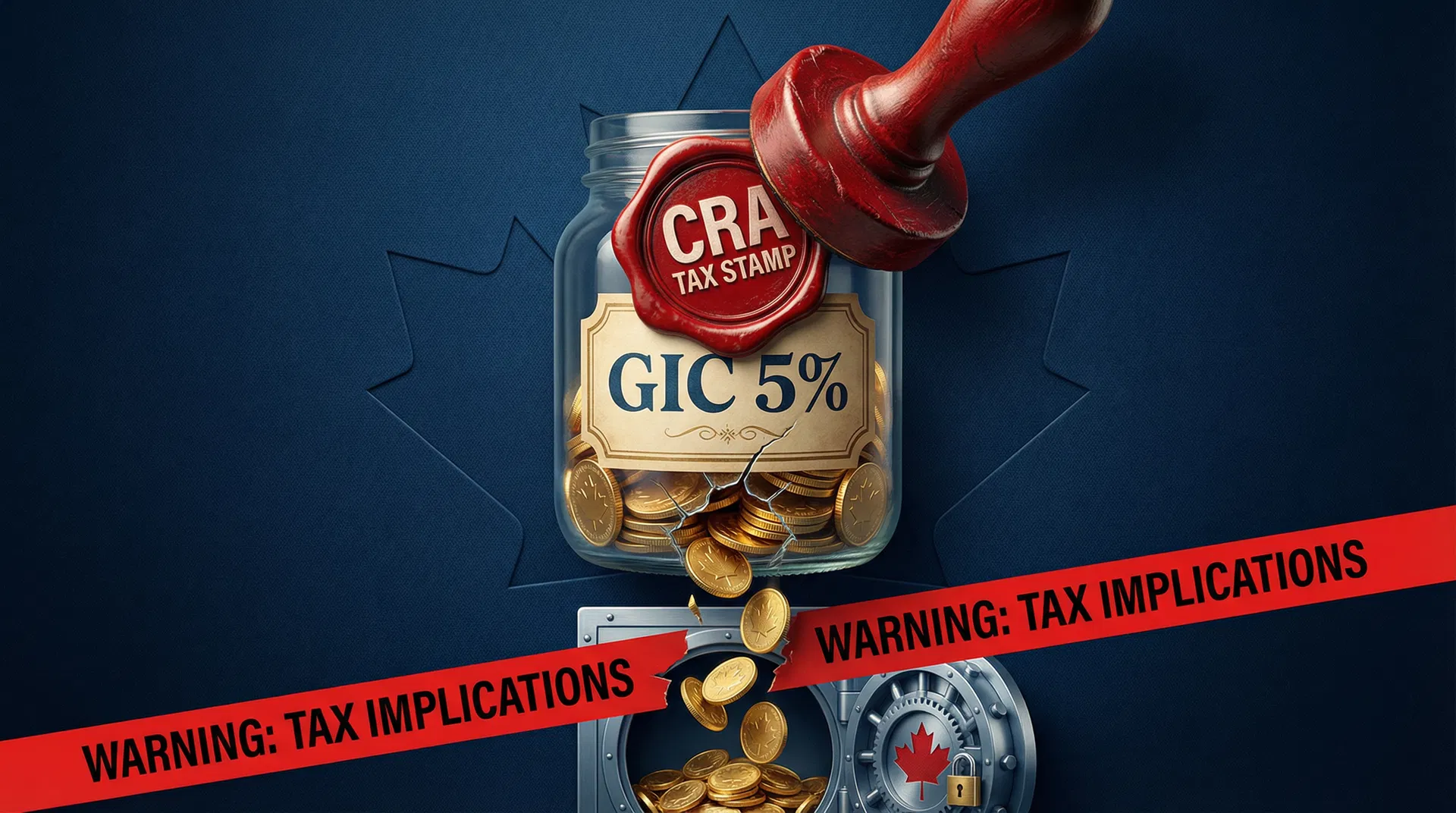
Think GIC is the safest investment? One client put $500K into a GIC, earned $25K in interest—and walked away with just $14K. The CRA quietly took nearly half. This isn't a GIC problem. It's a placement problem.
A Wake-Up Call: A Real Client Story
Three years ago, a client of mine put $500,000 into a GIC at 5% interest. The logic was airtight: principal protected, guaranteed return, no volatility, sleep well at night. Then tax season arrived.
The $25,000 in annual interest was added in full to his taxable income, pushing him into a 43% marginal tax bracket. His take-home from that $25,000? Just $14,000.
The bank used his half-million dollars for a full year. The CRA took nearly half the interest. And he was left with a number that looked good on paper but felt hollow in practice.
The Real Problem With GICs Isn't the Rate—It's the Tax Treatment
In Canada, not all investment income is taxed equally. Interest income—the kind GICs generate—is the least tax-efficient form of investment return. It's included in taxable income at 100%, with no deductions, no credits, no preferential treatment.
| Income Type | Included in Taxable Income | Tax Efficiency |
|---|---|---|
| Interest (GIC, HISA) | 100% | Lowest |
| Capital Gains | 50% | Moderate |
| Eligible Dividends | ~38% (after gross-up/credit) | Higher |
| Any income inside TFSA | 0% | Highest |
If your income is already in a high bracket, holding a GIC in a non-registered account means you're pairing the least tax-efficient investment with the least tax-sheltered account. It's the worst possible combination.
The Fix Is Simpler Than You Think: Change Where You Put It
GICs aren't the problem. The placement is. The principle is straightforward: the investment that generates the heaviest tax burden should be the first to go into a tax-sheltered account.
GIC interest is fully taxable, which means it should be the first thing you move into a TFSA. Inside a TFSA, that same 5% GIC becomes a 5% tax-free return—effectively doubling your after-tax yield compared to a non-registered account.
Many people do the opposite: they park a high-interest savings account (HISA) inside their TFSA, and leave the GIC in a non-registered account. The logic feels intuitive but the math is backwards.
An RRSP is another option. GIC interest inside an RRSP is tax-deferred until withdrawal—typically in retirement, when your marginal rate is lower. The compounding effect of deferring tax for 10–20 years is significant.
If Capital Preservation Is Your Goal, There Are Overlooked Alternatives
Many people choose GICs because they want safety and certainty. That's a legitimate goal. But within the universe of capital-protected options, the tax treatment varies considerably. Participating whole life insurance policies accumulate cash value that grows on a tax-deferred basis inside the policy. When structured correctly, that value can be accessed through policy loans in a way that generates minimal taxable income—a meaningful advantage for high-income earners in retirement planning.
Certain structured products may generate returns classified as capital gains rather than interest, cutting the effective tax rate nearly in half. These aren't right for everyone, but they're worth understanding before defaulting to a GIC in a taxable account.
The Bottom Line
GICs are a perfectly reasonable tool. The mistake isn't using them—it's using them without thinking about where they live in your financial structure. The same 5% rate can yield dramatically different after-tax results depending on the account it sits in. That's not a financial planning trick. It's basic tax literacy.
This article is for informational purposes only and does not constitute personalized tax or investment advice. Please consult a licensed professional for advice specific to your situation.